
Bespoke Outdoor Wellness House Construction

Mirror glass sauna

Architectural Glass Solution

Sky Residence wellness house
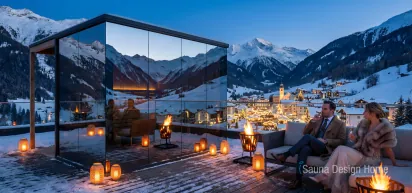
Mirrorsauna

VIP Equestrian Facility - Different from the Others

Outdoor sauna, wellness house, mini holiday home in custom sizes

Comprehensive Equestrian Facility Design

The sauna experience begins before you even step inside. Not on the bench, not during the infusion, and not during the minutes spent in the heat, but with the heating process itself. The few decisions you make at this stage, temperature, humidity and timing, determine whether the experience feels balanced and restorative or whether you are simply sitting in an overheated room. A properly prepared sauna provides even heat, does not place unnecessary strain on breathing and allows the body to adapt gradually. Extreme settings are not the goal. What matters is choosing the right parameters and allowing enough time for the sauna to heat through.
Many people give up regular sauna bathing because at some point the experience simply “didn’t feel right”. It may have been too hot, excessively humid, quickly exhausting, caused discomfort or simply failed to provide the expected experience. Often, the problem is not the sauna itself, but the preparation.
A well-functioning sauna is not about creating an extreme environment. It is about controlled heat exposure. Instead of fighting the heat, the body gradually adapts to it. Breathing becomes deeper, circulation increases and the nervous system begins to shift into a different state.
In practice, three main factors can be controlled in a sauna: temperature, humidity and heating time. The goal is not simply to reach a particular number on the display, but to create the right operating conditions.
A Finnish sauna is based on the combination of high temperature and low humidity. This is important because it allows the body to regulate heat efficiently through evaporation and sweating.
Set the temperature between 85 and 95°C and allow the entire sauna structure to heat thoroughly, usually for around 40 to 60 minutes. Humidity can then be adjusted through sauna infusions. The aim is to maintain a predominantly dry environment and periodically intensify the heat sensation with short bursts of steam. This rhythm, dry heat, steam and a return to balance, creates the characteristic Finnish sauna experience.
Around 1 to 2 dl of water is generally sufficient for a single infusion onto the sauna stones, and this can be repeated in approximately 5 to 10 minute intervals. The purpose is not to create continuous steam, but to briefly increase the perceived heat and then allow the environment to return to equilibrium.
Using too much water or performing infusions too frequently can make the air feel heavy, place greater strain on breathing and reduce one of the key advantages of dry sauna heat: the body's ability to regulate its own temperature naturally.
A properly functioning infusion is easy to recognise. The steam rises quickly, moves through the sauna and then disappears instead of remaining suspended in the air. If humidity is kept continuously high, evaporation slows down, the body's ability to release heat decreases and breathing can become more difficult. At that point, the characteristic nature of the Finnish sauna begins to disappear. A good sauna infusion is therefore not about maximum intensity, but about timing and proportion.
The advantage of a bio sauna is its gentler yet more sustained heat exposure. Lower temperatures combined with higher humidity allow the body to warm up more gradually. The heat feels fuller and softer without becoming excessively intense. The recommended temperature is generally between 55 and 65°C, while a sauna heater with an integrated steam function maintains a higher humidity level, typically around 20 to 60%. Here, the main tool is not the traditional infusion but a stable and carefully controlled environment.
The key is not to overheat the sauna, because doing so would remove precisely the comfort that distinguishes a bio sauna from a traditional Finnish sauna.
In an infrared sauna, the primary objective is not to heat the surrounding air but to direct infrared radiation towards the user's skin and underlying tissue. Philips Vitae infrared emitters require virtually no warm-up time, meaning the system is ready for use almost immediately.
Typical air temperatures range between 40 and 60°C, while the focus is primarily on session duration, usually around 20 to 40 minutes, and the selected intensity.
iSauna infrared saunas allow users to adjust both radiant intensity and temperature through the control system. The infrared emitters inside the cabin can also be divided into two independently controlled zones.
One of the most common mistakes does not happen during the sauna session itself, but during setup, when different operating modes are mixed together. Trying to use a Finnish sauna at a low temperature with very high humidity, or overheating a bio sauna, causes both systems to lose their intended characteristics.
The result is often the same: heavier breathing and an unstable, difficult-to-control sauna experience. Sauna bathing should not feel like an experiment. It should provide consistent and repeatable operation.
The intelligent iSauna control system makes this simple. Temperature, timing, infrared output, steam function, lighting and even a salt wall can be preset. Through the app, any sauna, whether indoors or outdoors, can be controlled precisely, even remotely. This turns home sauna use from trial and error into a consistently controlled experience.
