
Bespoke Outdoor Wellness House Construction

Mirror glass sauna
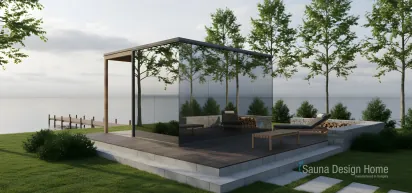
Architectural Glass Solution
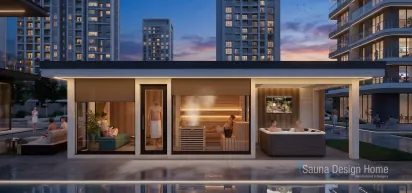
Sky Residence wellness house
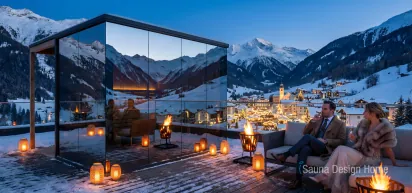
Mirrorsauna

VIP Equestrian Facility - Different from the Others

Outdoor sauna, wellness house, mini holiday home in custom sizes

Comprehensive Equestrian Facility Design

The true technical quality of an outdoor wellness house is not revealed on a mild summer day, but when temperatures outside drop below freezing while the sauna is operating inside. Under these conditions, the structure, glazing, construction joints, ventilation and heating capacity are all placed under load at the same time. In extreme cases, the temperature difference between a heated sauna cabin and the cold winter air outside can reach 80–100°C. The question, therefore, is not whether an outdoor wellness house can be used in winter, but whether it was designed from the outset to perform reliably under these conditions.
The appeal of winter sauna bathing is easy to imagine: warm wood, large glass surfaces, cold weather outside, and perhaps even snow. However, for the same level of comfort to be maintained in January, a precisely engineered structure is required behind the design.
An outdoor wellness house is not simply a larger version of a sauna cabin. The floor, walls, roof, windows and doors, as well as the technical systems, must function as one integrated system. If any one of these elements becomes a weak point, it can lead to greater heat loss, reduced comfort and, over time, structural problems.
Good thermal insulation does not simply mean thicker walls. The entire structure must be considered, from the floor to the roof and from structural joints to the glass surfaces.
The connection points are particularly important. A thermal bridge caused by a poorly designed junction can lower the temperature of interior surfaces, increase heat loss and, under unfavourable conditions, increase the risk of condensation. For this reason, we do not treat sauna insulation as an isolated layer, but as part of the complete structural build-up, airtightness and connection details. You can see further completed solutions among our references.
Large glass surfaces can be one of the defining features of a modern outdoor sauna house, but they also represent a significant thermal challenge. For year-round use, simply choosing “thicker glass” is not enough.
Depending on the system used, the glazing structure, coatings, spacers, gas filling and frame construction together determine its thermal performance. The aim is to reduce heat loss, maintain a higher interior surface temperature and minimise the risk of condensation. Panoramic glazing adds real value only when it does not compromise winter usability.
In winter, cold weather is not the only challenge. Warm air with higher humidity can cause condensation when it comes into contact with colder surfaces. If the structure and ventilation system are not designed for these conditions, the issue can become much more serious than a few fogged-up glass surfaces.
A properly designed air exchange system helps remove excess moisture, reduces the risk of condensation and protects the structure. Air intake, exhaust and the airtightness of the building must therefore be considered together. Humidity is not a defect, but a design factor. You can find further professional content on the technical and design aspects of sauna planning in our blog.
The required heater output is not determined solely by the volume of the sauna. Glass surfaces, uninsulated areas, the structural design and the conditions of use must also be taken into account. In an outdoor building, the winter heat loss of the entire structure must also be considered.
If the system has excessive heat loss, it should not simply be compensated for by installing a larger heater. The structure, glazing and ventilation must first be designed correctly, and the heating system should then be sized accordingly. For individually designed premium saunas, these factors are already essential at the very beginning of the design process.
If an outdoor wellness house is intended for year-round use, winter performance should not be treated as an optional extra. It must be considered from the very beginning, including the foundation, structural build-up, glazing, ventilation and sauna heater sizing.
The question is not whether an outdoor wellness house looks beautiful in winter. The real question is whether it performs just as well in January as it was expected to on the drawing board. Design your outdoor sauna house for year-round use with iSauna’s premium approach!
